

Table of Contents
Helena Petrovna Blavatsky (née Hahn von Rottenstern; 12 August 1831 – 8 May 1891), often known as Madame Blavatsky or HPB, was a Russian and American mystic, philosopher, and author. She co-founded the Theosophical Society in 1875 and became its primary theoretician.
Blavatsky promoted Theosophy as a synthesis of science, religion, and philosophy rooted in ancient wisdom traditions. Her major works, Isis Unveiled and The Secret Doctrine, introduced Western audiences to Eastern concepts such as karma, reincarnation, and spiritual evolution.
She recieved guidance from hidden masters and produced thousands of pages of esoteric writings despite persistent health challenges and public controversies.
Books
The book on this site by or about Blavatsky.
The Secret Doctrine
Early Life and Childhood
Helena Petrovna Hahn was born on 12 August 1831 (31 July Old Style) in Yekaterinoslav (now Dnipro, Ukraine), then part of the Russian Empire. She came from an aristocratic family with Russian, German, and French ancestry. Her mother, Helena Andreyevna Hahn (née Fadeyeva), was a self-educated novelist who died of tuberculosis in 1842 when Helena was eleven. Her father, Pyotr Alexeyevich Hahn, was a military officer.
The family moved frequently due to his career. After her mother’s death, Helena and her siblings lived with their maternal grandparents in Saratov. She received limited formal education but was largely self-taught. As a child, she showed a strong interest in the occult, exploring her great-grandfather’s library, which contained works linked to Freemasonry and figures such as Cagliostro.
She later described early psychic experiences, including visions of a “Mysterious Indian” figure she later identified as one of her spiritual teachers.
Early Travels and Formative Years
At age seventeen, in 1849, Blavatsky married Nikifor Vladimirovich Blavatsky, a much older vice-governor, but the marriage lasted only a few months. She separated from him and began extensive travels that lasted until 1873.
Her journeys took her across Europe, the Middle East, the Americas, India, and Tibet. She asserted that she met spiritual masters (Mahatmas) in Tibet around 1868–1870, studied under them, and received esoteric teachings.
These accounts remain largely uncorroborated by independent sources, and biographers note inconsistencies in her timelines. During this period, she reportedly developed and demonstrated psychic abilities such as clairvoyance and the ability to produce phenomena. She returned to Russia briefly in the late 1850s and early 1860s, where she exhibited paranormal events to family and acquaintances.
Move to America and Founding of the Theosophical Society
Blavatsky arrived in New York City in July 1873. In 1874, she met Henry Steel Olcott while investigating the Eddy brothers’ spiritualist phenomena in Vermont. The two formed a close partnership.
In 1875, along with William Quan Judge and others, they founded the Theosophical Society in New York.
The society’s stated objectives were to form a nucleus of universal brotherhood, encourage the study of comparative religion, philosophy, and science, and investigate unexplained laws of nature and latent human powers. Blavatsky served as corresponding secretary and became the movement’s leading intellectual force. She naturalized as a U.S. citizen in 1878.
Major Works and Teachings
Blavatsky’s first major book, Isis Unveiled (1877), criticized contemporary science and religion while arguing for the existence of an ancient, universal wisdom tradition. Her most significant work, The Secret Doctrine (1888), presented a comprehensive cosmological system involving seven root races, cycles of evolution, and the hidden history of humanity, including references to Atlantis and Lemuria.
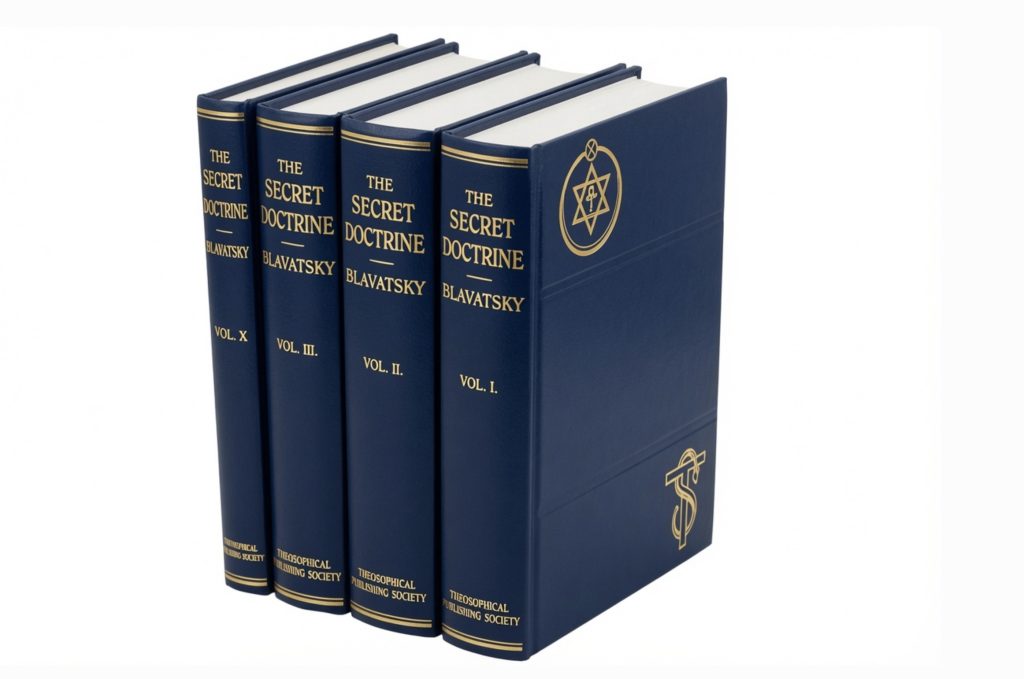
Other important publications include The Voice of the Silence (1889) and The Key to Theosophy (1889). Her teachings emphasized the unity of all religions, the existence of hidden masters guiding human evolution, reincarnation, karma, and the development of latent spiritual faculties through study and ethical living.
India Period and Controversies
In 1879, Blavatsky and Olcott moved to India and established the society’s international headquarters at Adyar, near Madras (now Chennai). They edited the journal The Theosophist and gained a significant following among Indians interested in reviving traditional spiritual knowledge.
In 1884, while Blavatsky was in Europe, two former employees, the Coulombs, accused her of faking phenomena and producing fraudulent “Mahatma letters” through a trapdoor. The Society for Psychical Research (SPR) sent Richard Hodgson to investigate.
His 1885 report concluded that she was a fraud who had fabricated many of the phenomena. Blavatsky vehemently denied the charges and left India permanently in 1885. A later SPR study in the 1980s partially criticized the Hodgson Report and suggested Blavatsky had been treated unfairly.
Later Years in Europe
After leaving India, Blavatsky lived in Germany, Belgium, and finally London. Despite declining health, she continued writing and teaching. She completed The Secret Doctrine in Würzburg and Ostend before moving to London in 1887, where she founded the Blavatsky Lodge. Her later years were marked by intense literary output and efforts to clarify Theosophical doctrines for Western audiences.
Death
Helena Blavatsky died on 8 May 1891 in London at age 59 during the influenza pandemic. She was cremated at Woking Crematorium. Theosophists commemorate her death annually as White Lotus Day.
Accomplishments and Legacy
Blavatsky co-founded the Theosophical Society, which grew into a global organization with branches worldwide. Her writings introduced Eastern philosophical concepts such as karma and reincarnation to Western audiences and helped spark renewed interest in occultism and comparative religion.
Theosophy influenced later movements and figures, including Rudolf Steiner (who later split to form Anthroposophy) and Annie Besant. Her emphasis on universal brotherhood and the synthesis of science and spirituality left a lasting mark on modern esoteric thought.
Critics and Controversies
Blavatsky faced repeated accusations of fraud, particularly following the Hodgson Report, which damaged her reputation among skeptics and some spiritualists.
Critics have also charged her with plagiarism in Isis Unveiled, claiming she borrowed heavily from earlier sources without sufficient attribution. Some contemporaries and later scholars viewed her claimed travels and encounters with masters as fabricated or exaggerated.
Defenders argue that she was a genuine mystic and synthesizer who faced unfair attacks from both scientific materialists and rival occult groups. Her ideas on race and human evolution have drawn modern criticism for containing elements now considered outdated or problematic. Despite these controversies, her role as a pioneering figure in the Western occult revival remains widely acknowledged.


Comments are closed.