
Table of Contents
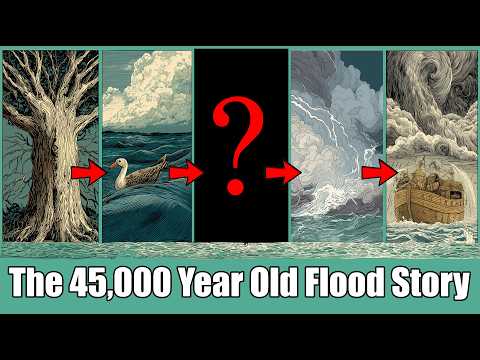
Crecganford rejects the claim that flood traditions almost everywhere, with Noah or Gilgamesh as the famous cases, prove one global drowning during the life of modern humans. Manu sacrifices after the water falls. Yima encloses seeds of humans, animals, and plants instead of using a boat. A Mesopotamian god sends the flood because humans are noisy. The other kind remembers land lost to a rising ocean. He cites about thirty meters over many centuries, a northern British memory of hunting where islands now stand. Yearly Nile floods and drought stories show that water trouble was not one event. A single recent worldwide flood would have left a simple family tree. He wants early records from before missionaries, compared by a footprint method he calls phylogenetics. Work he credits to a researcher named Julian tracks an underground origin, then a soil diver, then fruit knocked into water, with Eurasian forms later moving back toward northern Africa. That is not one outbound migration. Central Asia is ruled out as the source, and American versions are not treated as the root.
Key points
- Shared plots about an angry deity, from Manu’s sacrifice to a Mesopotamian noise flood, do not by themselves prove one global disaster.
- Another set of tales matches a measurable ocean rise, including a northern British memory of hunting where islands now stand.
- Crecganford keeps those drowned landscape memories apart from stories in which rain ends the world and life begins again.
- He expects origin narratives to absorb a flood over time, rather than flood narratives turning into origin narratives.
- Motif tracking he attributes to Julian shows movement inside Eurasia and back toward northern Africa, not a single departure from Africa.
- Central Asia is rejected as the starting point, and American versions are not treated as the probable root.
Short quotes
If we examine the data, flood stories are told all around the world or almost so.
Crecganford, How flood stories spread
He grants the wide distribution that people cite when they argue for one shared disaster. Watch at 12:48
We have the stories and can confirm the sea level rise through geology.
Crecganford, How flood stories spread
For memories of drowned land, he says the tales and the geological record point to the same ocean rise. Watch at 22:06
These are not stories where the rain causes flooding, where the earth is reborn.
Crecganford, How flood stories spread
He separates coastline memories from the other plot, in which a downpour ends the world and life starts over. Watch at 25:57
In effect, humans were not migrating one way out of Africa.
Crecganford, How flood stories spread
The migration picture he favors is not a single march leaving Africa. Watch at 58:36
What we can say is the data also indicated clearly that central Asia is not the origin of the flood myth.
Crecganford, How flood stories spread
One result he stresses is that these tales did not begin in Central Asia. Watch at 1:18:18
Video by Crecganford. Watch on YouTube.