
Table of Contents
Visit to Şanlıurfa Museum
The presentation begins with a visit to Şanlıurfa Museum in southeastern Turkey, located in the ancient city of Edessa. This city is in proximity to Göbekli Tepe, Karahan Tepe, and another pre-pottery Neolithic site, Yenimahalle, where the “Earth of Man” artifact was discovered and is displayed in the museum.
The Painted Boar Statue
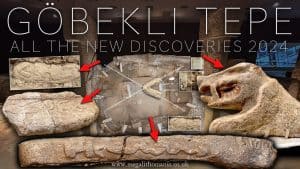
A recently discovered statue from Göbekli Tepe, known as the Painted Boar Statue, was highlighted. Found in Enclosure D, the statue features red, white, and black pigments, suggesting it was painted. Measurements of the statue are approximately 1.35 meters (4.43 feet) wide and 0.7 meters (2.3 feet) tall. The statue’s design includes tusks, a tongue, and possible depictions of human heads, indicating its ceremonial significance.
It is hypothesized that this statue may symbolize the transition of the spirit into the afterlife. Archaeologists suggest its creation dates to around 8,700 BCE, slightly later than the initial occupation of Göbekli Tepe in 9,600 BCE.
Reconstruction of Enclosure D
A reconstruction of Enclosure D at Göbekli Tepe is displayed in Şanlıurfa Museum. The space is dominated by monumental T-shaped pillars, including the Vulture Stone, Porthole Stone, and other intricately carved megaliths. The carvings often depict abstract human figures and animal motifs.
Notable features include:
- The Porthole Stone: The Painted Boar Statue was located beneath this stone.
- Pillar 43: Positioned near the boar statue, it features elaborate carvings.
Additional Discoveries in Enclosure D
A large stone slab measuring 2.8 meters (9.19 feet) long and 1.38 meters (4.53 feet) thick was uncovered. The slab features motifs such as H and C shapes and serpent carvings. Nearby, a wild boar jaw was found, indicating possible ceremonial or sacrificial practices.
A slab embedded in the wall of Enclosure D includes carvings aligned with the winter solstice sunrise. Alignments were verified using astronomical simulations for 9,500 BCE.
New Finds in Enclosure C
Another part of a porthole stone with relief carvings, including a boar motif, was discovered along the Dromos Avenue leading to Enclosure C. This avenue features a U-shaped entrance stone. Enclosure C is often referred to as the “Building of the Boar” due to the prevalence of boar carvings.
Symbolic and Astronomical Connections
Research on the H symbol found at Göbekli Tepe reveals possible links to astronomical alignments, such as solstices. The symbol may represent two pillars framing the horizon. Alignments between the summer and winter solstice sunrises are also reflected in specific carvings and features.
A stone scepter discovered in 1997 with H symbols carved on it further emphasizes the symbolic importance of these motifs.
Early Discoveries and the Role of Farmers
The first artifacts from Göbekli Tepe, including a fertility statue, were found by local farmers in the 1980s. Initially dismissed, these artifacts led to the site’s discovery in the 1990s after archaeologist Klaus Schmidt investigated the area.
Conclusion
The presentation concludes with a call to explore the artifacts at Şanlıurfa Museum and to learn more about the rich Neolithic history of Göbekli Tepe and surrounding sites. Visitors are invited to join upcoming tours of archaeological sites in Turkey.
Comments are closed.