
Table of Contents
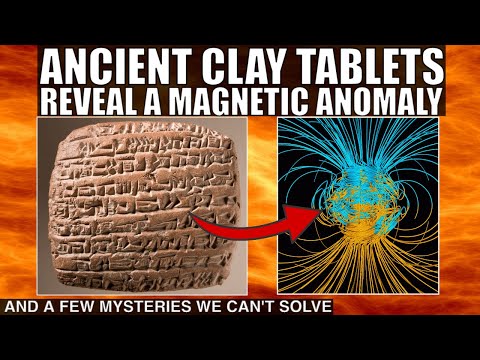
Anton Petrov starts from a clay tablet that is probably a beer tab, then reports on the planetary magnetic field. Mesopotamian clay often holds iron oxides that can lock in the field from the time the object was made. A 2009 look at dozens of Middle Eastern samples, he says, found the field at least three times stronger, perhaps well beyond one region. Newer work on bricks tries to date other clay from that record. The rise looks fast, a matter of decades, then a drop, and it may have repeated several times, perhaps four, leaving a strength far above today’s average. Usual theory puts the source in the outer core, so a sudden leap means something there shifted or some large interior mass disturbed it. He does not name the cause. Pottery, in this report, can register a magnetic crisis no chronicle describes, which matters for dating clay and for models of the planetary shield.
Key points
- Iron oxides in Mesopotamian clay can preserve a record of Earth’s magnetic field from the time the clay was made.
- A 2009 set of Middle Eastern samples showed the field strengthening by at least three times.
- Later brick studies try to use that record as a dating tool for other clay objects.
- Petrov describes a fast rise over a few decades, a drop, and a pattern that may have repeated about four times.
- Because the field is generated in the outer core, he says a sudden spike implies a major change deep inside the planet.
- The report treats the cause as unknown and the clay as evidence archaeology and space science can both use.
Short quotes
we know that iron oxides or magnetite very often leaves behind a very specific fingerprint of Earth's magnetosphere
Anton Petrov, Magnetic anomaly in Mesopotamian clay
Magnetic minerals in clay are his reason an old tablet can still record the ancient field. Watch at 1:42
the magnetic field must have strengthened by at least three times
Anton Petrov, Magnetic anomaly in Mesopotamian clay
The Middle Eastern samples, in the report, require a field several times stronger than expected. Watch at 3:55
it seems to have happened several times in this case potentially at least four times
Anton Petrov, Magnetic anomaly in Mesopotamian clay
He presents the spike as a repeated event, not a single odd reading. Watch at 7:15
Video by Anton Petrov. Watch on YouTube.