
Table of Contents

Plato on the soul in the Laws
In The Laws, in Benjamin Jowett’s translation, the Athenian stranger places the soul next to the Gods in honour, and in Book X he argues that it is prior to the body.
ATHENIAN: Listen, all ye who have just now heard the laws about Gods, and about our dear forefathers:--Of all the things which a man has, next to the Gods, his soul is the most divine and most truly his own.
Plato, The Laws, Book V, 726a (Jowett)
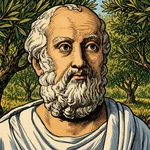
The soul is among the first of things
In Book X he says nearly all men are ignorant of the nature and power of the soul, and do not know that she is among the first of things, and before all bodies.
ATHENIAN: Nearly all of them, my friends, seem to be ignorant of the nature and power of the soul, especially in what relates to her origin: they do not know that she is among the first of things, and before all bodies, and is the chief author of their changes and transpositions. And if this is true, and if the soul is older than the body, must not the things which are of the soul's kindred be of necessity prior to those which appertain to the body?
Plato, The Laws, Book X, 892a-c (Jowett)
The self-moved, and prior to the body
He defines the soul as the motion which can move itself, and he concludes that the soul is the first origin and moving power of all that is, the oldest of all things, and prior to the body, which is born to obey it.
ATHENIAN: And what is the definition of that which is named 'soul'? Can we conceive of any other than that which has been already given--the motion which can move itself?
CLEINIAS: You mean to say that the essence which is defined as the self-moved is the same with that which has the name soul?
ATHENIAN: Yes; and if this is true, do we still maintain that there is anything wanting in the proof that the soul is the first origin and moving power of all that is, or has become, or will be, and their contraries, when she has been clearly shown to be the source of change and motion in all things?
CLEINIAS: Certainly not; the soul as being the source of motion, has been most satisfactorily shown to be the oldest of all things.
ATHENIAN: And is not that motion which is produced in another, by reason of another, but never has any self-moving power at all, being in truth the change of an inanimate body, to be reckoned second, or by any lower number which you may prefer?
CLEINIAS: Exactly.
ATHENIAN: Then we are right, and speak the most perfect and absolute truth, when we say that the soul is prior to the body, and that the body is second and comes afterwards, and is born to obey the soul, which is the ruler?
Plato, The Laws, Book X, 895e-896b (Jowett)
The soul in The Voice of the Silence
In The Voice of the Silence (1889), Blavatsky presents a discipline in which the lower self and the senses give way to a higher SELF of Spirit. The fragments are her account of precepts she says she translated from a Book of the Golden Precepts. No such source manuscript has been shown.
The Mind as slayer of the Real
The first fragment opens by presenting the mind as the thing that kills the Real, and by telling the disciple to slay that slayer.
The Mind·is the great Slayer of the Real. Let the·Disciple·slay the Slayer.
H. P. Blavatsky, The Voice of the Silence, The Theosophical Publishing Company, Limited, London, and W. Q. Judge, New York, 1889, Fragment I, p. 1

Before the soul can see
On the next leaf she says the soul cannot see until the harmony within is reached, and until fleshly eyes are made blind to illusion.
Before the soul can see, the Harmony within must be attained, and fleshly eyes be rendered blind to all illusion.
H. P. Blavatsky, The Voice of the Silence, The Theosophical Publishing Company, Limited, London, and W. Q. Judge, New York, 1889, Fragment I, p. 2
The Self of matter and the SELF of Spirit
Later in the same fragment she sets the self of matter against the SELF of Spirit, and says the two cannot occupy the same ground.
The Self of matter and the SELF of Spirit can never meet. One of the twain must disappear; there is no place for both.
H. P. Blavatsky, The Voice of the Silence, The Theosophical Publishing Company, Limited, London, and W. Q. Judge, New York, 1889, Fragment I, p. 12
Mind as a mirror
In The Two Paths she compares the mind to a mirror that gathers dust while it reflects. Soul-Wisdom, in her account, is what brushes that dust away, and the beginner is told to blend mind and soul.
For mind is like a mirror ; it gathers dust while it reflects. It needs the gentle breezes of Soul-Wisdom to brush away the dust of our illusions. Seek O Beginner, to blend thy Mind and Soul.
H. P. Blavatsky, The Voice of the Silence, The Theosophical Publishing Company, Limited, London, and W. Q. Judge, New York, 1889, Fragment II, p. 26

