
Table of Contents

Transcription
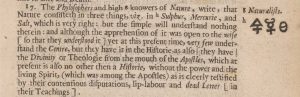
17. The Phylosophers and high knowers of Nature, write, that Nature consisteth in three things, viz. in Sulphur, Mercurie, and Salt, which is very right: but the simple will understand nothing therein: and although the apprehension of it was open to the wise [so that they understood it] yet at this present time, very few understand the Centre, but they have it in the Historie, as also they have the Divinity or Theologie from the mouth of the Apostles, which at present is also no other then a Historie, without the power and the living Spirit, (which was among the Apostles) as is cleerly testified by their contentious disputations, lip-labour and dead Letter in their Teachings.
Modern English Rendering
The philosophers and great students of nature write that nature consists of three principles: sulphur, mercury, and salt. This is indeed correct, but ordinary people understand nothing of it. Although the wise once grasped this knowledge [so that they truly understood it], at present very few understand the Centre. Instead, they only have it in the form of a history, just as they have theology from the Apostles. But theology now is nothing more than history also, without the power and the living spirit (which was among the Apostles). This is plainly shown by their contentious disputes, empty words, and reliance on the dead letter of their teachings.
Notes
- Sulphur, Mercury, Salt: In alchemy, these are the three prime principles (tria prima), taught especially by Paracelsus.
- Sulphur = fiery principle (combustibility, soul).
- Mercury = volatile, fluid principle (spirit).
- Salt = fixed, solid principle (body, matter).
- The text contrasts the living spiritual understanding with the dead literal interpretation.
- It criticizes theologians of the writer’s own time for reducing apostolic teaching to dry disputes and “dead letters.”
⚖️ This is both alchemical (three principles of nature) and mystical-theological (warning that true wisdom is lost, replaced by lifeless doctrine).


Comments are closed.