
Table of Contents
Nicolas Notovitch, a Russian journalist, published this book in French in Paris in 1894. He was born in 1858. He says that in 1887 he was at Himis, a Buddhist monastery near Leh, in Ladakh. A lama, he says, read him a Tibetan life of Saint Issa, and an interpreter put it into words he could write down. Issa is the name he uses for Jesus. He says he later grouped the verses himself.
This is a claimed discovery of a manuscript. It is not a historical record of the life of Jesus. It is not a channeled book. I give the text here as a historical document of the claim.
Scholars have widely treated the claim as unproven, and many call it a hoax. In October 1894 F. Max Müller published “The Alleged Sojourn of Christ in India” in The Nineteenth Century, volume 36, pages 515 to 522. He did not believe the story. He wrote that the monks at Himis may have invented the tale for a visitor who wanted it, and that the other reading was that Notovitch had made it up. In 1896 J. Archibald Douglas published “The Chief Lama of Himis on the Alleged ‘Unknown Life of Christ’” in the same magazine, volume 39, pages 667 to 677. Douglas had gone to Himis. He wrote that the chief lama denied any Life of Issa in the monastery. The lama also denied that a European with a broken leg had stayed there in the fifteen years he had been chief.
The book spells the place Himis. The usual spelling now is Hemis. A gonpa, the word in one chapter title, is a Buddhist monastery. Thibet is the book’s spelling of Tibet.
Contents
- Preface
- A Journey in Thibet
- Ladak
- A Festival in a Gonpa
- The Life of Saint Issa
- Resumé
- Explanatory Notes
Credits and public domain
The words are Project Gutenberg ebook 29288, prepared by David Edwards, Paul Motsuk, and the Project Gutenberg Online Distributed Proofreading Team. I took out the Gutenberg header, footer, and license. I did not rewrite the book.
The translation in that ebook is by J. H. Connelly and L. Landsberg. The title page printed in the ebook reads “New York: R.F. Fenno. 1890.” and “The Original Text of Nicolas Notovitch’s 1887 Discovery.” I compared the opening with the 1894 New York edition of the same translation, published by G. W. Dillingham (Internet Archive bib_fict_9736973). The wording matches. Edgar J. Goodspeed, in Strange New Gospels (University of Chicago Press, 1931), says this translation was entered for copyright on 18 May 1894 and published by G. W. Dillingham, and that R. F. Fenno reprinted it in 1926 with the copyright date printed as 1890. The Gutenberg catalog title also says “1877 discovery.” That year is not on the title page. The preface dates the journey in India to 1887. 1877 is the Turkish war in the first sentence.
The Gutenberg HTML marks a handful of small misprints, such as “inevitablys” and “Than” for “Then.” I kept the corrected readings the proofreaders printed. I did not collate the ebook line by line against a Fenno copy.
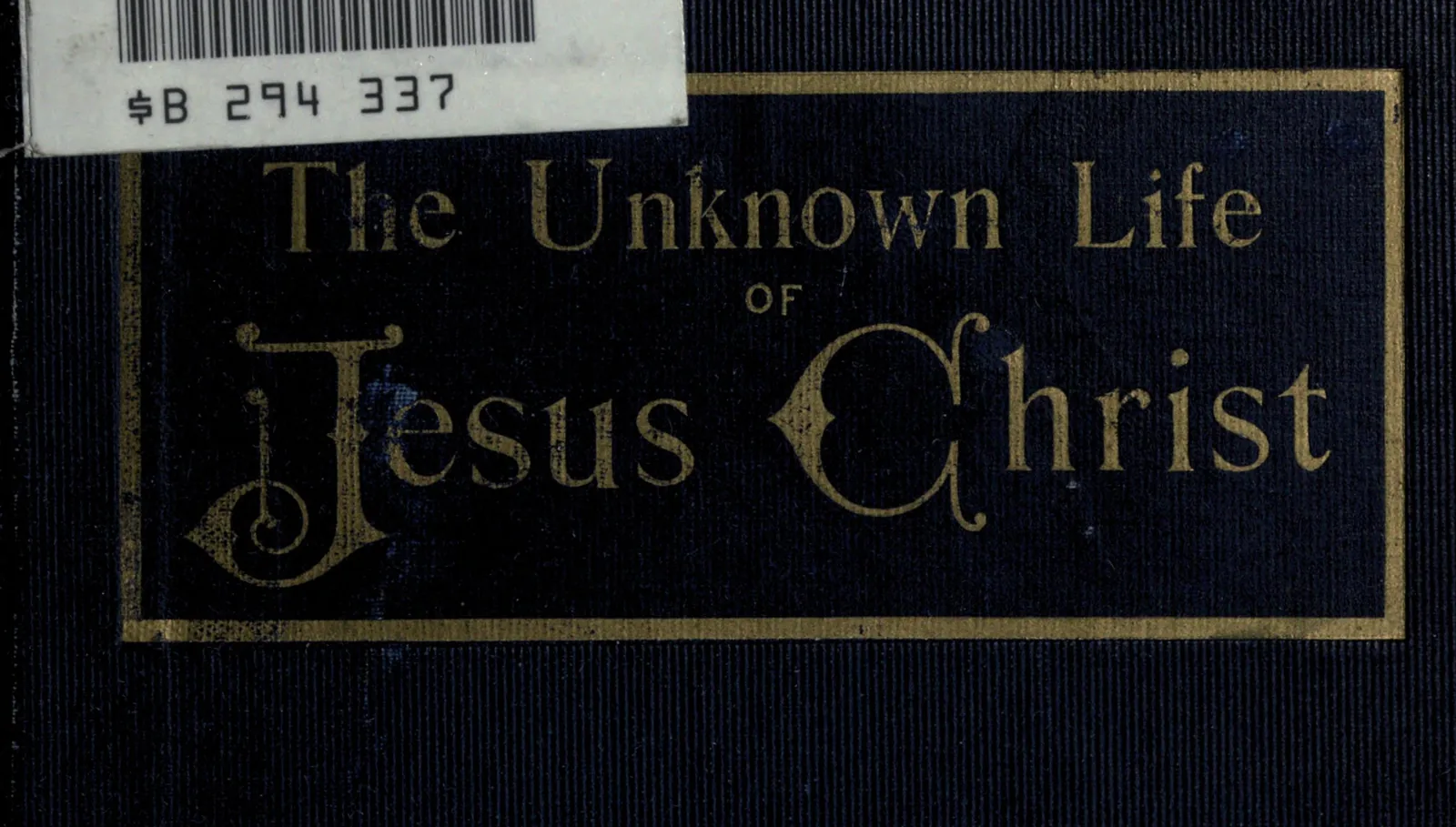
The cover scan is a different translation. Internet Archive unknownlifeofjes00notorich is Alexina Loranger’s English, fourth edition, Indo-American Book Company, Chicago, 1916, copyright 1894. The library record says it was translated from the French. I went through the 212 leaves. That copy has no frontispiece, no plates, and no map. The picture leaves are the cloth cover, an owner’s bookplate, a blank back board, and the camera color cards. The picture on this page is the cloth cover, cut to the stamped title. I left the bookplate and the color cards out. They are not part of the book.
The French book came out in 1894. The English translations of 1894, and the Fenno reprint of 1926, are in the public domain in the United States. Notovitch was born in 1858. I have not found a settled year for his death. He is still on record after 1916.