
Table of Contents
Thucydides of Athens wrote this history of the war between Athens and Sparta. He says he began at the moment the war broke out, because he believed it would be a great war, more worthy of relation than any that had come before. He tells it by summers and winters. The text stops in the twenty-first year, while a sacrifice to Artemis at Ephesus is still the last thing told, and the war is not over. The usual date given for his death is about 400 BCE.
This is a historical record. It is not a novel. It is not a channeled book. In Book I he says how he worked. He did not take the narrative from the first source that came to hand. Part of it is what he saw himself, and part is what others saw for him. He says the reports were tested as closely as he could test them, and that the work cost him labour, because witnesses of the same event did not agree. Where he could not carry a speech word for word, he made the speaker say what the occasion demanded, keeping as close as he could to the sense of what was really said. That way of working is the model of Greek historical method.
The name Atlantis does not occur in this book. I searched this English text for it.
I put it on this site because of that method, and because of what Book I and Book III record about the Greek past.
Book I opens on early Greece, before the war. Later readers call this part the Archaeology, his inquiry into the old time. He says the country then had no settled population and no common name. He names Hellen, son of Deucalion, and says the name Hellas spread from Hellen and his sons. Deucalion, in Greek story, is the man who lives through a flood. Thucydides does not tell that flood. He only gives the father’s name, and he moves on to what fleets and walls he thinks the evidence can support.
In that same opening he names the first man that tradition credits with a navy.
And the first person known to us by tradition as having established a navy is Minos. He made himself master of what is now called the Hellenic sea, and ruled over the Cyclades, into most of which he sent the first colonies, expelling the Carians and appointing his own sons governors.
Thucydides, The History of the Peloponnesian War, Book I, Chapter I, translated by Richard Crawley
The Cyclades are the ring of islands in the sea he calls the Hellenic sea. A thalassocracy is rule held by ships. In this account Minos holds those islands, sets his own sons over them, and clears the pirates out so that the revenue is his.
Book III records a disaster inside the war, not a tale of the first ages. The printed heading of Chapter V dates the spring before the war to 431 B.C. Thucydides then counts the years forward. On page 176 of the 1876 printing, in the fourth year, the margin reads B.C. 428. He closes the fifth year, and in the next summer earthquakes turn a Peloponnesian army back at the Isthmus of Corinth. About the same time the sea at Orobiae, a town in Euboea, draws back from the shore and returns in a huge wave. What had been land is left as sea. People who cannot reach the higher ground are killed. A flood of the same kind strikes Atalanta, the island off the Opuntian Locrian coast. That coast is Locris, the mainland shore facing Euboea, north of Boeotia. The wave carries away part of the Athenian fort there and wrecks one of two ships drawn up on the beach. At Peparethus, the island later called Skopelos, the sea draws back a little, without a flood, and an earthquake throws down part of the wall, the town hall, and a few other buildings. He says what he thinks caused it.
Without an earthquake I do not see how such an accident could happen.
Thucydides, The History of the Peloponnesian War, Book III, Chapter XI, translated by Richard Crawley
Where the shock was strongest, he writes, the sea was driven back, and then it rushed in and made the flood. That summer, counted from 431 B.C., is 426 BCE. This is a Greek historian setting down a real disaster of his own war, and arguing a cause.
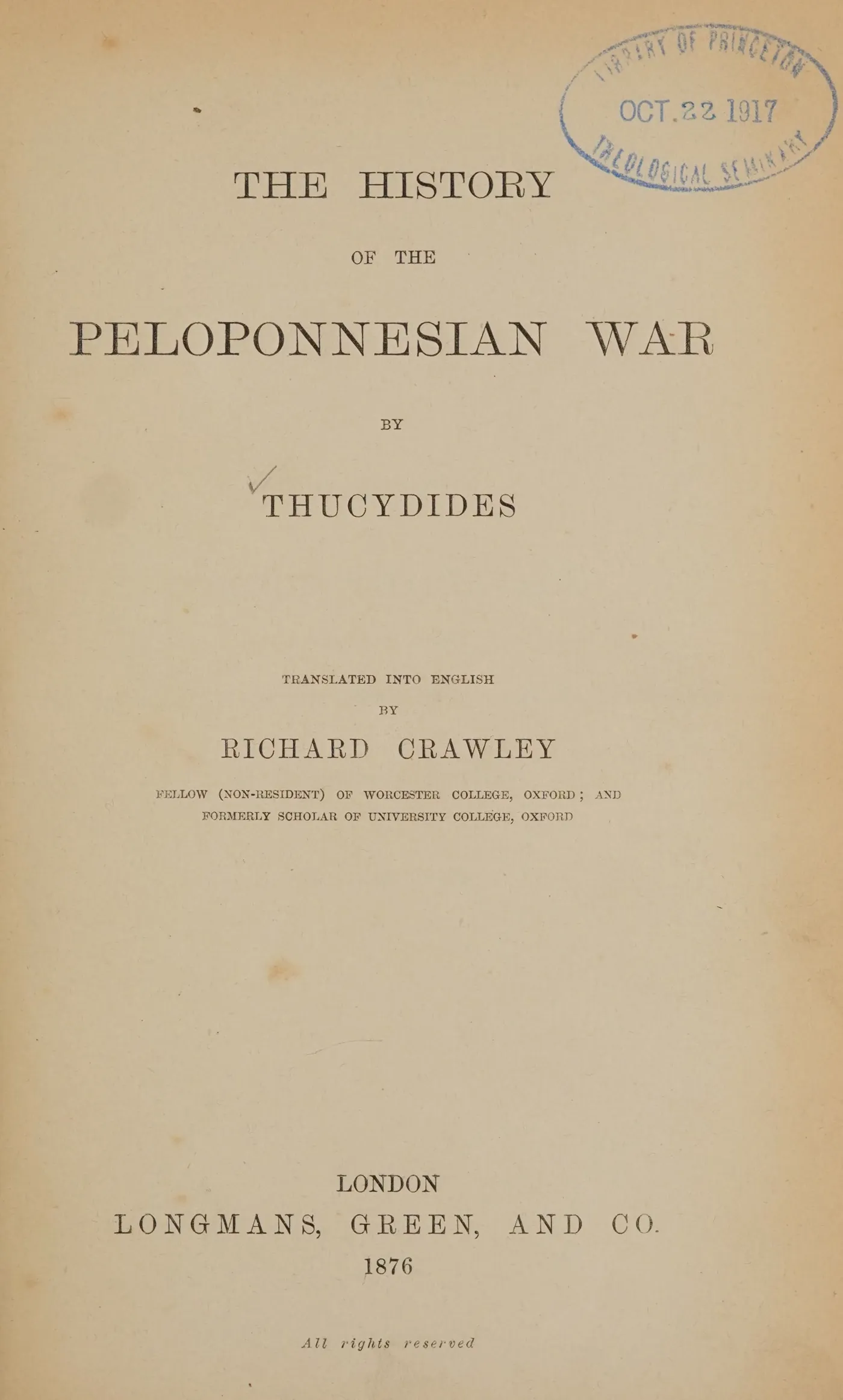
Richard Crawley made the English. The preface says he finished the last six books in 1873. Longmans, Green, and Co. of London published the translation. The title page of the copy I used is dated 1876. The catalog of that copy says the first edition of this translation is London, 1874.
Crawley numbered his chapters straight through the eight books, from I to XXVI. He did not start again at I in each book. In the preface he says he made these breaks himself, and that the old Greek section numbers stayed at the top of each printed page. Those marginal numbers are not in the text below.
Contents
- Preface
- Book I, Chapters I to III
- Book I, Chapters IV and V
- Book II
- Book III
- Book IV, Chapters XII and XIII
- Book IV, Chapter XIV
- Book V
- Book VI
- Book VII
- Book VIII
Book I and Book IV are the long ones. I split Book I after Chapter III, and Book IV after Chapter XIII. The other books are each one page.
Credits and public domain
The eight books are the narrative of Project Gutenberg ebook 7142. I took out the Gutenberg header, the footer, and the license. I did not rewrite the narrative.
I checked that file against the scan Internet Archive historyofpelopon00thuc_1. The title page reads London, Longmans, Green, and Co., 1876. The catalog description of the copy says “First edition of this translation: London, 1874.” I compared the opening of Book I and the close of Book VIII with the scan. The wording matches. I did not collate every line.
Two headings in the Gutenberg file do not match the print. I followed the scan. Chapter V is headed “The Spring before the War (B.C. 431)”. The Gutenberg file had a different heading there. Chapter XI in the print begins “Sixth Year of the War”. The Gutenberg file had dropped the word “Sixth”. The printed title of Chapter XXII spells Obstinacy. The Gutenberg file had Obstinancy in that one heading, and I corrected it. The errata on page xxxiii of the scan say to read Epidaurus for Epidamnus on page 18, and charge for change on page 176. The Gutenberg text already has those two readings. At the end the scan prints “THE END OF THE HISTORY.” The Gutenberg file prints “THE END”. I used the words on the scan.
The 1876 book also prints Crawley’s preface, which is on the preface page. It prints a summary of events as the contents, on pages xi to xxxiii, with the years B.C. and the page numbers of that edition. The same notes stand in the margins of the text pages. After the history it prints an index of names. Gutenberg ebook 7142 does not include that summary or that index. I did not retype them. Their page numbers belong to the 1876 printing.
This copy has no map and no plate. The archive.org record gives a foldout count of 0. I read the front of the book through the errata on page xxxiii, and I looked through later pages, including the publisher’s list bound in at the back. The only picture that belongs on a cover is the title page. The cloth of the binding is plain.
The leaf before the title page names the printer, Spottiswoode and Co., New-street Square and Parliament Street, London.
Thucydides died about 400 BCE. Richard Crawley was born on 26 December 1840 and died on 30 March 1893. The Times printed his obituary on 8 April 1893. The translation was published in 1874, and the printing I used is 1876. The title page of that printing says “All rights reserved.” In the United States the text is in the public domain.