
Table of Contents
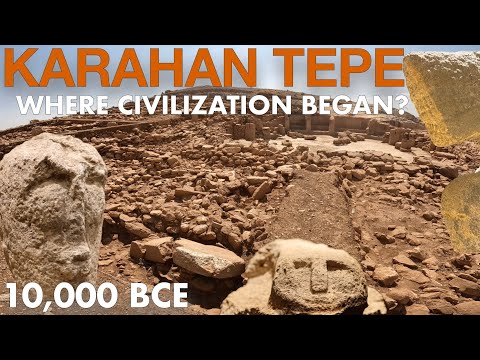
History Time asks whether the hill now called Karahan Tepe, in the dry uplands east of Sanliurfa, shows large scale society before farming. The film follows the dig from a nameless find to a mapped complex of T shaped pillars, hundreds of them across the slopes, set in the same age as Gobekli Tepe and possibly older and larger. No pottery and no tame plants or animals are reported, so the builders are cast as complex foragers. Chambers cut into the slope, phallic pillars, and a gaunt male figure are read as fertility and display. Hybrids, including a leopard coming out of a human body, are set beside Paleolithic cave images. Shamanic practice, costume, drums, and mind altering plants are offered as one way to read that art, while the narrator warns that temple is too small a word for enclosures that may have been buried after a single use. Rival centers, seasonal festivals, and a comparison with later Stonehenge frame the hill as an early moment when many groups spent huge labor on a shared rite.
Key points
- Karahan Tepe is a hilltop complex of T shaped pillars in the same early horizon as Gobekli Tepe.
- The absence of pottery and of domestic plants or animals is used to call the builders foragers.
- Phallic pillars, a gaunt male figure, and animal human hybrids dominate the carved program.
- Shamanism, with costume, drums, and altered states, is one proposed reading, not a settled fact.
- Enclosures may have been used and then buried, perhaps by rival groups rather than one church.
- The film compares the gatherings with Stonehenge, while stressing that farming and surplus came later.
- Group ritual, not a lone shrine, is the change the narrator thinks matters.
Short quotes
In those days, it had no name, but today it's famous, named for a nearby hill known worldwide as Karahan.
History Time, Karahan Tepe and early gatherings
The site enters the story as a hill that only later received this name. Watch at 3:47
Still, not one shard of pottery has ever been found, nor any evidence of domesticated plants or animals.
History Time, Karahan Tepe and early gatherings
Those absences are why the builders are described as complex foragers. Watch at 13:58
But why would a leopard be depicted bursting out from a human form or vice versa?
History Time, Karahan Tepe and early gatherings
Hybrid carvings are the puzzle he links to shamanic transformation. Watch at 28:15
Shamanism is a concept seen all over the world in all different cultures at all different times.
History Time, Karahan Tepe and early gatherings
He uses the worldwide pattern as a cautious analogy, not as a label carved on the stones. Watch at 40:40
Video by History Time. Watch on YouTube.