
Table of Contents
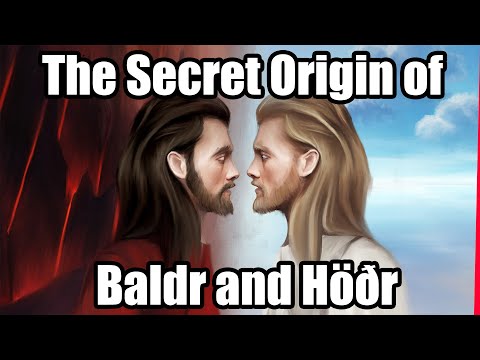
Crecganford sets the Old Norse death of Baldr beside Saxo Grammaticus’s longer Danish version, two branches of an older Germanic story. Baldr is Odin’s bright son. Frigg makes the world swear not to harm him, then skips a sprig she thinks too slight. Loki learns the gap, blind Hodr throws it, and Baldr dies. Hermod pleads with Hel, a ship becomes the pyre, and Loki is later bound under a snake whose venom hits his face. In Saxo the pair are rival suitors for Nanna. Baldr cannot be beaten until Hodr fetches a distant sword and charms from forest women. Both plots, the channel argues, keep a long journey for the single object that can kill him. The weapon began as a plant such as a reed or thistle, and mistletoe was added later. Tears, brightness, and a spring from the ground lead him to call Baldr a sky and weather god and Hodr an underworld power. A crucifixion parallel is mentioned only as Sophus Bugge’s theory.
Key points
- In the Norse version told here, Frigg’s universal oath has one gap, and that overlooked sprig is what kills Baldr.
- The aftermath includes a funeral on a ship and Loki bound where dripping venom can reach his face.
- Saxo turns the pair into rival suitors, and Hodr obtains a special sword and charms that make him win.
- The channel argues that both versions preserve a distant quest for a killing plant later misremembered as mistletoe.
- Baldr is read as a bright sky power linked with weather and growth, and Hodr as his dark opposite.
- A resemblance to the crucifixion is reported only as Sophus Bugge’s idea, not as the channel’s conclusion.
Short quotes
The branch went through Baldr, leaving him with a mortal wound.
Crecganford, Baldr and Hodr
In the Norse telling, this is the blow that ends the life of the beloved god. Watch at 6:32
Above Loki’s head a poisonous snake was fixed to drip poison on Loki’s face.
Crecganford, Baldr and Hodr
The channel includes Loki’s later binding, with venom falling on him, as part of the same myth cycle. Watch at 12:09
Nanna's father Gevar is afraid to displease Baldr, as Baldr is invulnerable and cannot be overpowered, a theme we see in Old Norse myth.
Crecganford, Baldr and Hodr
Saxo’s Danish account makes the rival suitor impossible to beat by ordinary force, which is why the bride’s father hesitates. Watch at 16:52
Firstly, that a journey has to be made to a place a long way away to retrieve the item that will eventually kill Baldr.
Crecganford, Baldr and Hodr
Comparing the two tellings, he lists a long trip to obtain the fatal object as a shared plot point. Watch at 22:45
If effect, it was a plant that killed Baldr in the original myth, but not mistletoe, this was brought into the myth later.
Crecganford, Baldr and Hodr
His reconstruction is that some plant was the weapon, and that the familiar shrub entered the story only afterward. Watch at 26:21
The weeping, the light of Baldr, all point to him being a Sky God, and Höðr the opposite, a god of the underworld.
Crecganford, Baldr and Hodr
He treats grief and brightness as clues that one figure rules the sky and the other the world below. Watch at 32:11
Video by Crecganford. Watch on YouTube.